How a port earns its money, told through one ship, one cargo and one week on the quay.
Company figures are for FY26, the year ended 31 March 2026, unless a year is named. Dollar amounts convert at Rs 87. Industry ranges are typical Indian figures rather than company disclosures, so treat them as ranges. This is analysis, not investment advice.
1. The ship that costs $1,000 an hour to do nothing
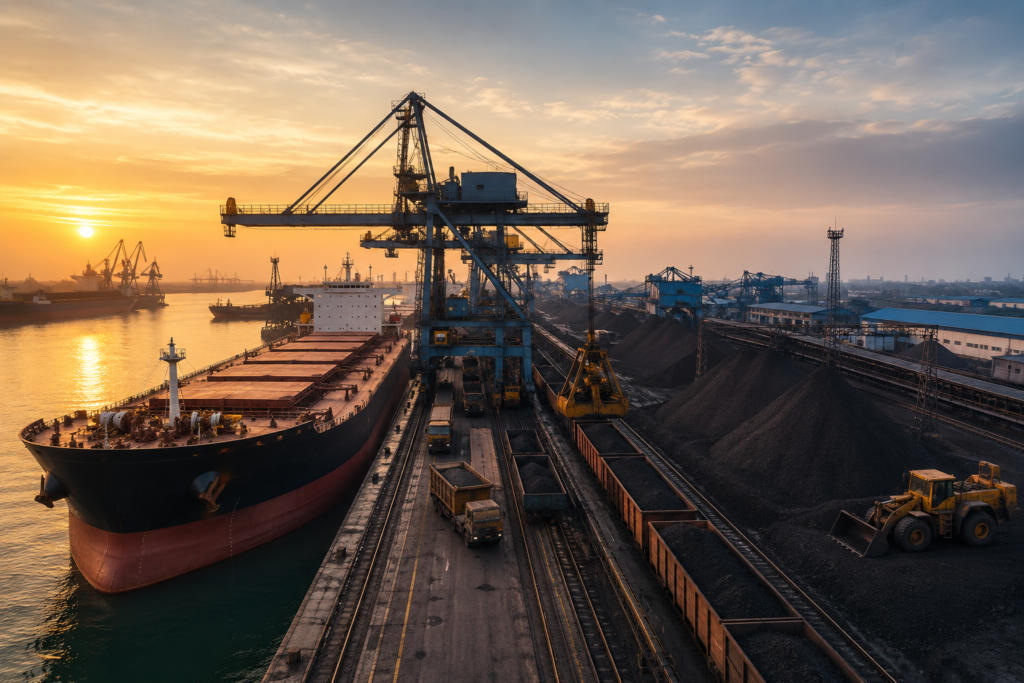
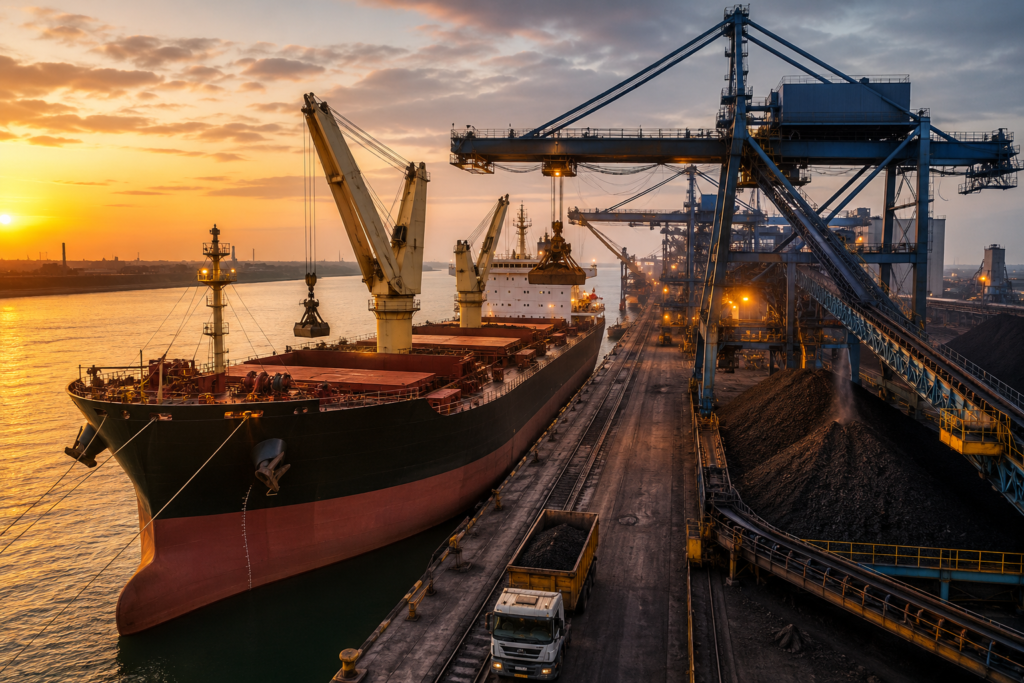
At six in the morning, nine miles off the Odisha coast, a Capesize bulk carrier tenders Notice of Readiness, the master’s formal declaration that his ship is ready to work cargo. Call her the Cape Kestrel. She is 292 metres long, drawing 17.6 metres, and she has 150,000 tonnes of Australian coking coal in her holds. The steel plant that bought the coal is 340 km inland and runs on about four days of stock.
She cannot come in. A berth is occupied and there is a swell running at the outer anchorage. She waits three days.
That wait is expensive. Hire and bunkers on a ship this size run somewhere near $25,000 a day, a bit over $1,000 an hour. The meter does not care whether she is steaming, discharging or swinging on her anchor.
Who pays depends on the contract. On a voyage charter, the buyer pays a freight rate that includes a fixed allowance of time for loading and discharge, called laytime. Once laytime is used up, the buyer pays the ship owner demurrage at a rate agreed months earlier, say $28,000 a day. On a time charter, the buyer pays hire every single day and the waiting is simply his problem.
Either way, someone is paying about $1,000 an hour for a ship to sit still, and not one rupee of it reaches the port.
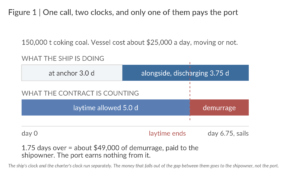
Hold on to the $1,000 an hour. Everything that follows is an argument about whose clock is running.
2. From hook to gate
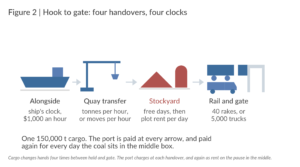
Marine services. She berths on the morning of day three. Four rope gangs, two tugs, a pilot, and then the grabs start.
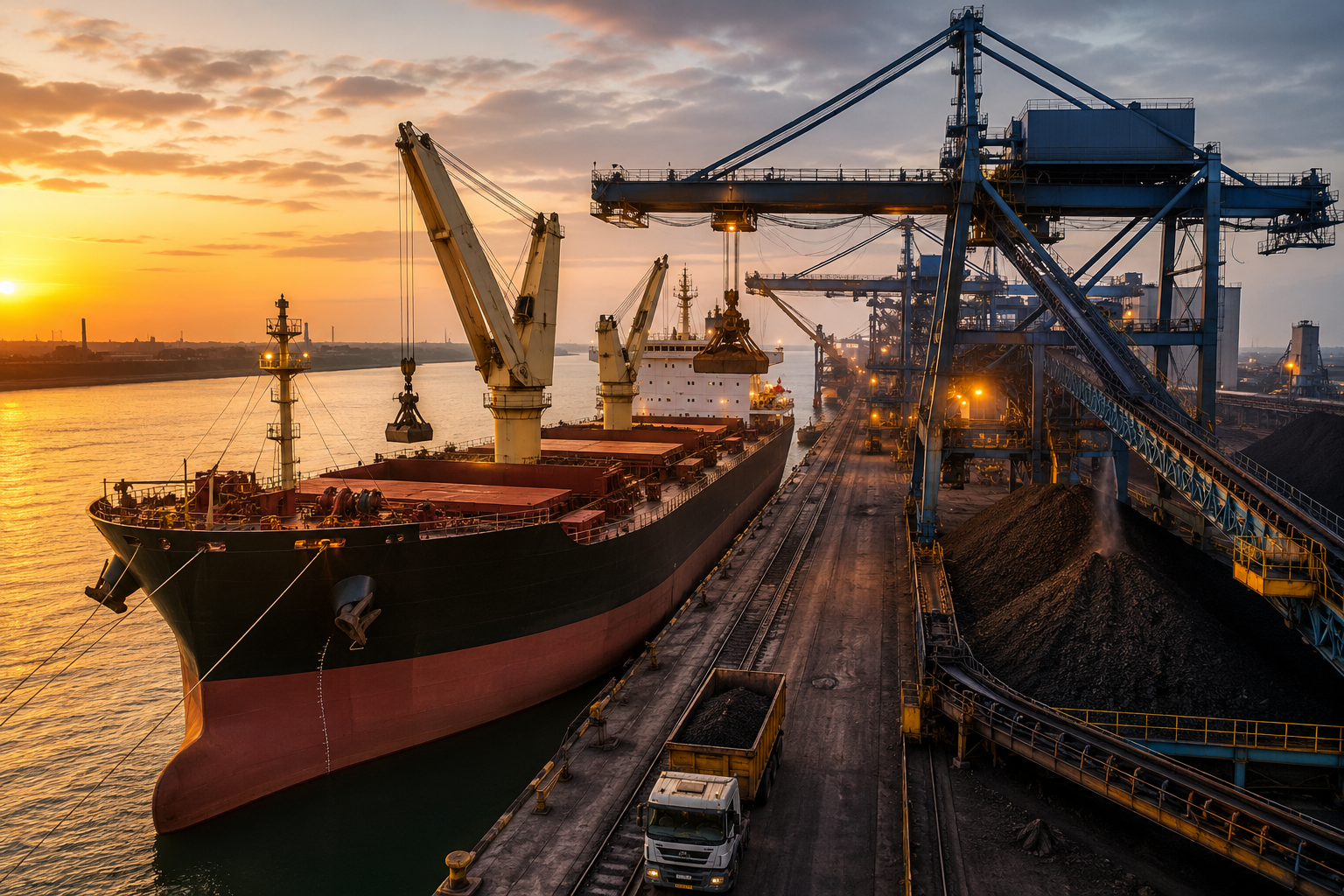
Cargo handling. A mechanised Indian bulk berth moves 30,000 to 45,000 tonnes of coal a day when the weather holds and the yard keeps up. At 40,000, the Cape Kestrel is empty in 3.75 days. Grab cranes lift coal from the holds into hoppers on the quay. Hoppers feed conveyors or tipper trucks. The coal goes to a stockyard behind the berth, laid out in rows by grade and by owner, because two buyers’ coal must never touch.
Storage. The yard is where the port starts earning a second kind of money, and where the cargo’s own clock starts.
Logistics. From the yard the coal leaves by rail or by road. A rake is roughly 58 wagons and carries about 3,800 tonnes, so this one cargo is about 40 rakes. The railway runs a clock as well: a rake placed for loading gets a few free hours, after which somebody pays wagon demurrage. By road at 30 tonnes a truck, the same cargo is 5,000 truck trips through one gate. That arithmetic is the whole reason rail connectivity decides which ports can grow. A port without evacuation fills its yard, then slows its cranes, then stops taking ships.
She sails on day 6.75, 1.75 days past her laytime, leaving about $49,000 of demurrage behind her.
3. Who pays whom, and for what
Four separate revenue lines come out of that week, and they behave differently enough that mixing them will lead you to the wrong conclusion about the business.
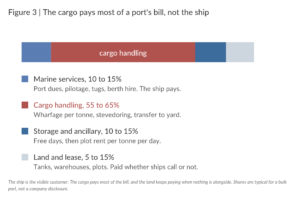
Marine services. Port dues on entry (charged per gross tonne, which measures the ship’s enclosed volume rather than her cargo), pilotage, tug hire, and berth hire for every hour alongside. The ship pays for these, or her agent does. On a Capesize call like this one they add up to somewhere around $60,000 to $90,000. Real money, and the smallest of the four lines at a typical bulk port. It is not small everywhere. Adani Ports owns 183 vessels and 64 dredgers and sells the service at its own ports and at other people’s, and marine work is 23% of its group EBITDA.
Cargo handling. Wharfage, charged per tonne just for crossing the quay, plus stevedoring, which is the labour and gear that works the cargo out of the holds, plus transfer to the yard. The cargo pays. At an all-in $3 to $5 a tonne for bulk in India, this call bills roughly $600,000 in total, of which about $500,000 is the cargo side. Around Rs 5 crore, in a week, from one ship.
Storage and ancillary. Every cargo gets a few free days, typically three to seven. After that the port charges plot rent per tonne per day, and the rate usually steps up in slabs the longer the cargo stays. Add weighing, sampling, bagging, and equipment hire. High margin, almost no extra capital, and it rises when the hinterland is slow to collect. That is an uncomfortable feature of the business model, and it is real.
Note the trap in the vocabulary here. The Cape Kestrel‘s demurrage went to the ship owner because the cargo buyer used more laytime than he bought. The plot rent goes to the port because the cargo buyer left his coal on the ground. Two different meters, two different payees, similar names.
Land and lease income. Tank farms, warehouses, container freight stations, industrial plots behind the quay. Contracted, annual, and largely indifferent to whether ships call this quarter. This is the line that makes a port’s reported revenue per tonne look strange. Adani Ports collected about Rs 773 a tonne in FY26, near $9. That is far above the $3 to $5 a tonne you would expect from handling bulk cargo. The reported figure carries containers, logistics and SEZ land inside it.
4. Volume and realisation move on their own
Port revenue is tonnes multiplied by rupees per tonne, and those two numbers are set by different people for different reasons.
Volume comes from the hinterland: how much steel gets made, how much coal gets burned, how many boxes the region imports. Then it comes from share against the next port up the coast, from capacity commissioned in time, and from contracted or captive cargo that cannot easily go elsewhere.
Realisation per tonne comes mostly from mix. A tonne of containerised cargo earns several times what a tonne of coal earns, so a container berth commissioned in March moves the whole company’s average. After mix comes pricing freedom. India runs 12 central government major ports, which lived under a tariff regulator for decades, alongside several hundred state-licensed non-major ports that have always set their own prices. Then comes the share of storage and value added services in the total, and how much of the tariff is dollar-linked.
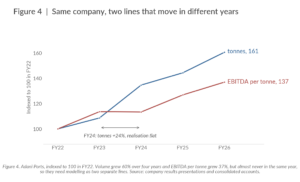
Adani Ports handled 312 million tonnes in FY22 and 500.8 million in FY26, up 60%. Over the same four years EBITDA per tonne went from Rs 333 to Rs 456, up 37%. The two lines did not move together year by year. FY24 added 81 million tonnes, a 24% jump in volume, and EBITDA per tonne finished the year at Rs 378 against Rs 379 the year before. Flat. FY25 did the opposite: volume up 7%, realisation up 12%.
Gujarat Pipavav makes the point from the other side. In FY25 its container volume fell about 14%, to roughly 749,000 TEU (twenty-foot equivalent units, the standard way of counting boxes). Profit after tax rose about 16%. Mix, tariff and cost did the work while the tonnage went backwards.
5. The cost base barely moves, and that decides everything
Once a terminal is built, most of its cost is already spent or already committed. Depreciation on the dredged channel, breakwater, berths, cranes and conveyors. Interest. Maintenance dredging, which the channel needs whether one ship calls or a hundred. Minimum manning, security, insurance, and any fixed payment owed under the concession.
What genuinely varies with the next tonne is short: power and fuel for the equipment, extra stevedore shifts, contracted haulage, and any royalty calculated as a share of revenue. For a mechanised bulk terminal, something like two thirds of the cash cost base sits on the fixed side.
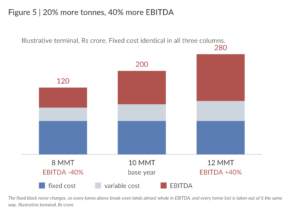
Take a simple terminal. It handles 10 million tonnes at Rs 500 a tonne, so revenue is Rs 500 crore. Fixed costs are Rs 200 crore and variable costs are Rs 100 a tonne. EBITDA is Rs 200 crore, a 40% margin.
Add 2 million tonnes through the same berth. Revenue goes up Rs 100 crore, variable cost goes up Rs 20 crore, and EBITDA goes up Rs 80 crore. Volume rose 20% and EBITDA rose 40%.
Lose 2 million tonnes instead and the arithmetic runs backwards at the same speed. EBITDA falls 40%, and the margin drops from 40% to 30% without a single tariff being cut.
This is not a textbook artefact. Between FY24 and FY25 Adani Ports added Rs 4,368 crore of revenue and Rs 3,161 crore of EBITDA, so 72 paise of every extra rupee of revenue reached EBITDA. That is what a good year looks like. It is also exactly why a port with one expiring concession, or one customer at 30% of volume, is dangerous even while it is reporting a 60% margin.
6. Landlord, tool, operating: who carries the risk
Four ownership models sit behind almost every port in the world, and they decide who keeps the operating leverage described above.
| Model | Who owns what | Who runs the cranes | Who carries volume risk | Where you see it |
| Operating (service) port | Authority owns land, berths, cranes | Authority’s own labour | Authority, and ultimately the taxpayer | India’s old major ports, still partly today |
| Tool port | Authority owns berths and cranes, hires them out | Private stevedore | Split: authority on capital, stevedore on productivity | Uncommon now, survives in pockets |
| Landlord port | Authority owns land and water, operator builds superstructure | Private operator under a 25 to 30 year concession | Operator, who also pays a royalty | JNPT, most major-port terminals, most of the world |
| Fully private port | One owner holds land, marine, terminal, rail | Owner | Owner, entirely | Mundra and the other state-licensed non-major ports |
The landlord model is where the fine print earns its keep. The operator pays the authority a royalty, usually a share of revenue. In the bidding wars of the 2000s some Indian terminal operators promised more than half their revenue away, and several of those terminals never recovered from the bid. A royalty set as a percentage of revenue at least falls when volume falls. A guaranteed minimum royalty does not, and that is the clause that has bankrupted terminals.
A fully private port keeps every rupee of the chain, from pilotage to plot rent to the industrial land behind the quay. It also carries the dredging, the connectivity and the demand risk with nobody to share them.
7. Where the moat sits, and what eats it
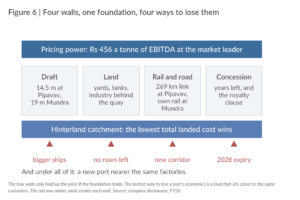
Hinterland catchment comes first. A port’s real market is the set of factories and consumers for which it offers the lowest total landed cost, inland freight included. Indian rail freight for bulk runs somewhere around Rs 1.5 to Rs 2.5 per tonne-km, so a rival port 250 km further from the plant starts Rs 400 to 600 a tonne behind. The port’s own charge, Rs 350 to 700 a tonne, is smaller than that gap. Geography and rail corridors decide most of the contest before anyone competes on service.
Draft decides which ships can come. Pipavav takes about 14.5 metres, Mundra works up to 17 to 19, Jaigarh about 20. Vessel size sets ocean freight per tonne. On the same route, a Capesize carries coal or ore at roughly a third less per tonne than a Supramax, a ship of about 60,000 tonnes. A deep port hands its customers a discount that no shallow rival can match at any tariff.
Rail and road are the drain. Gujarat Pipavav’s 269 km rail link moves over 30% of its cargo. Adani built private rail into Mundra. Without evacuation the yard fills, the cranes slow, and the catchment shrinks to whatever a truck can reach.
Concession length is an end date. Gujarat Pipavav’s concession runs out in September 2028 and, as of mid-2026, no extension has been secured. Every other number in that company’s file is hostage to that one line. A terminal with a fixed expiry is a wasting asset until somebody renews it, and the renewal is a negotiation the operator does not control.
Switching costs vary wildly. A spot bulk cargo can be diverted next month. A steel plant built behind the port, fed by a dedicated conveyor or a take or pay slurry pipeline, cannot move at all. JSW Infrastructure’s own group cargo is 52% of its volume. That is the strongest wall in Indian ports, and the most concentrated one, because it is a single counterparty.
Five things erode all this. A new deep-water port closer to the same hinterland, and Vadhavan north of Mumbai, at a planned Rs 76,000 crore, is the current example. A new rail corridor that changes relative inland costs. Tariff regulation returning by policy. A customer building or buying its own berth. And the cargo itself disappearing: thermal coal volumes are a genuine long-term question for several Indian ports, and no amount of draft fixes a cargo that stops arriving.
8. What to carry into the annual report
Three habits follow from all of the above.
Read EBITDA per tonne across five years next to volume, never on its own. One line tells you about the region. The other tells you about the mix and the pricing. A company can be winning on one while losing on the other.
Find the concession table and write down every expiry date and every royalty clause. A port company is a bundle of end dates, and the market often prices it as a perpetuity.
Then ask who the top three customers are and what it would cost them to leave. A tonne that cannot go anywhere else is worth more than a tonne that can, and the accounts will not tell you which kind you own.
The companion post puts these tests to work on the two listed Indian port companies, Adani Ports and JSW Infrastructure. It ends up somewhere the presentations do not: on the same return on capital for both.
The Cape Kestrel is a composite, built from typical Capesize dimensions and 2025 to 2026 charter rates. She is not a specific voyage. Company figures are from results presentations and consolidated accounts. This is analysis, not investment advice.